Use Case · Athletic Recovery
Hydrogen therapy for athletic recovery
Between the work and the next day’s work.
The gap between today’s session and tomorrow’s is where training actually happens. Research suggests molecular hydrogen may support what your body does in that gap — the lactate clearance, the next-morning stiffness, the willingness to go again.
The morning after a hard session has its own quality. Stairs that ask a little more than they did yesterday. A first walk to the kettle that’s slower than usual. The body, doing the thing it always does — remembering what you asked of it, and quietly settling the bill.
For most of us, that bill is the whole point. The work happens between sessions, not during them. Which is why anything that might support the recovery side of the equation is worth a closer look — provided the research is honest about what it shows.
This page is about what a growing body of peer-reviewed research has explored on molecular hydrogen inhalation and the recovery window. What it suggests. What it doesn’t. And how some of our customers — Joanne C. in particular — have come to use hydrogen therapy as part of how they train.
New to molecular hydrogen? Start with what is hydrogen therapy.

The Research
What the research suggests.
A randomised controlled trial published in Biology of Sport in 2019 looked at what 7 days of molecular hydrogen inhalation does to running performance in healthy adults. Twenty participants, double-blinded, placebo-controlled crossover design — the kind of study design that earns its conclusions. Each participant inhaled either 4% hydrogen or room air for 20 minutes a day, with a washout period between conditions. After 7 days of hydrogen, peak running velocity in an incremental maximal test increased by up to 4.2% compared with placebo. The authors concluded that inhaled hydrogen appears to show ergogenic properties — careful wording that matches the brand’s own preference for not overclaiming a single trial.
A few other studies are worth knowing about, even though most of the wider athletic-recovery literature has used hydrogen-rich water rather than inhalation. The mechanism is shared; the delivery differs.
A 2019 randomised trial by Botek and colleagues in the International Journal of Sports Medicine found that hydrogen-rich water before exercise improved ventilatory responses, perceived exertion, and lactate clearance compared with placebo. A 2012 pilot study in Medical Gas Research — ten elite soccer players, double-blind crossover — found that hydrogen-rich water consumed before heavy exercise prevented the usual rise in blood lactate and reduced the early decline in muscle function. More recently, a 2024 trial in Frontiers in Physiology tracked elite fin swimmers through two strenuous training sessions performed on the same day. The group supplementing with hydrogen showed measurably better muscle recovery markers at 24 hours.
A note in the spirit of honesty. Not every study has found an effect. Some trials on maximal aerobic performance, peak heart rate, or treadmill time-to-exhaustion have shown no significant difference between hydrogen and placebo. The field is still working out which dose, which duration, and which type of athlete sees what. What’s emerging across the literature, taken as a whole, is that hydrogen therapy may support the recovery side of the training equation more reliably than the peak-performance side — the lactate, the perceived effort, the next-day soreness. We think that’s the more honest reading of where the evidence sits today.
The Mechanism
How it might work.
Molecular hydrogen is the smallest molecule in the universe — small enough to pass through a cell membrane without needing a receptor or a transporter. Once inside, research suggests it can selectively neutralise the most damaging free radicals (the hydroxyl radical chief among them) while leaving the signalling molecules your body uses for normal function intact. That selectivity is what distinguishes hydrogen from broad-spectrum antioxidants, which can blunt the very oxidative signals that drive training adaptation.
Hard exercise is, in a real sense, a controlled oxidative event. Working muscle generates reactive oxygen species; some of that signal is what tells the body to adapt, and some of it is collateral damage. The hypothesis a lot of the research is testing is whether molecular hydrogen can quietly reduce the collateral damage without interfering with the adaptive signal. It’s a sophisticated bet, and it explains why the research interest in hydrogen and exercise has grown steadily over the past decade.
There’s a separate, practical question worth addressing here: does inhalation at the flow rates our machines use actually deliver enough hydrogen to matter? A 2020 study in the Journal of Clinical Medicine Research by Motoaki Sano and colleagues at Keio University answered that directly. In an animal model, inhaling pure hydrogen through a standard nasal cannula at a low flow rate of 250 ml/min produced arterial blood hydrogen concentrations comparable to levels the wider literature considers therapeutically active. In other words: a low-flow nasal cannula — the same delivery method our machines use — gets hydrogen into the bloodstream at concentrations the research takes seriously. Our Hydro Nova delivers 1500 ml/min — more than six times the rate that study tested.

What It Feels Like
What it feels like.
Joanne C. came back to running in her late forties. She’d been a runner in her twenties — half-marathons, the occasional road race — and stopped for the years that fill in between. When she started again, the running itself was fine. It was the day after that surprised her.
“I started using it on training days. By month two I was using it every day.”
— Joanne C., customer
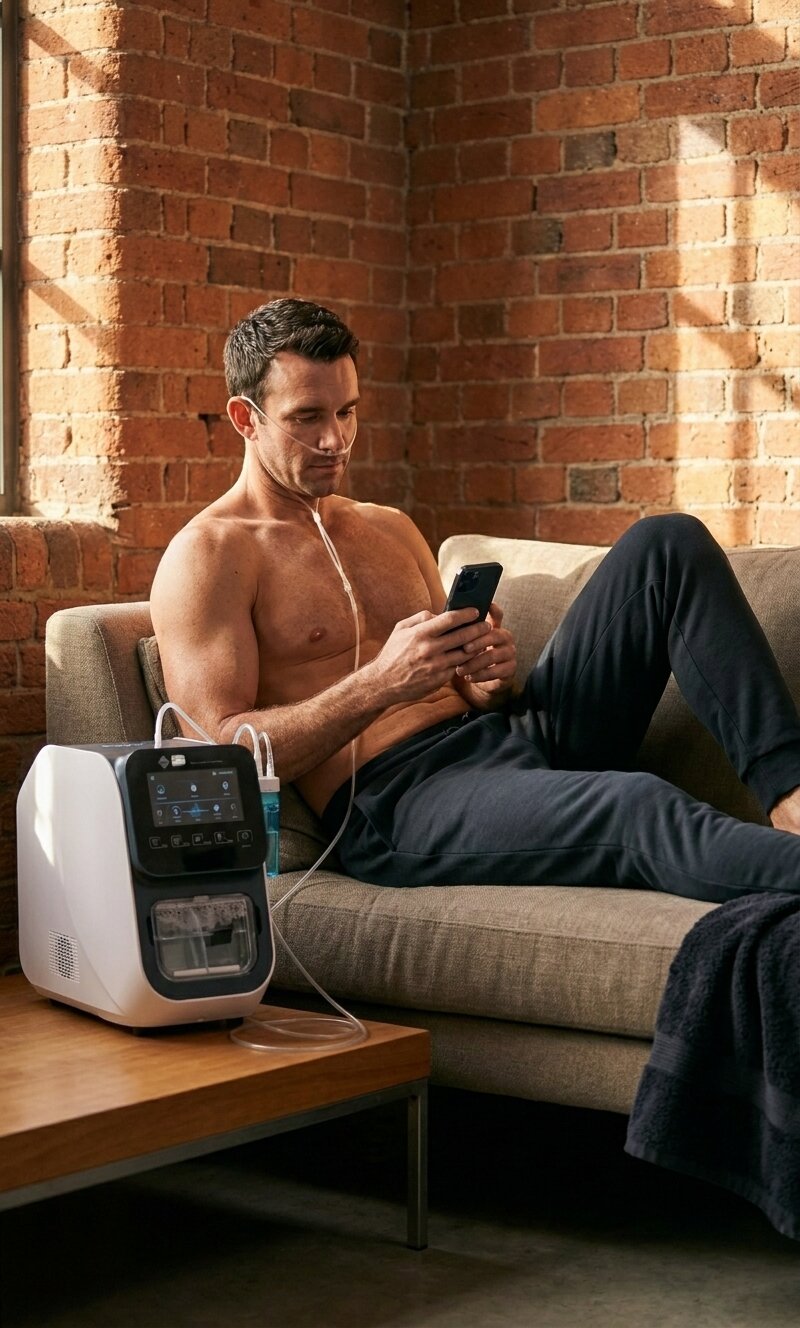
She bought a Hydro Nova in the autumn. For the first month she used it the way most people start out: after a hard session, sitting on the sofa with the cannula on, twenty or thirty minutes, the steady quiet of it. By the second month she’d shifted. She used it on rest days too. Not because anything dramatic had happened — there was no morning of waking up transformed — but because the days she’d used it felt incrementally better than the days she hadn’t, and that incremental difference compounded across a training week.
That pattern — the move from “use it on hard days” to “use it every day” — is one many of our customers describe. The recovery support seems to be cumulative rather than acute. It isn’t the kind of intervention that announces itself. It’s the kind you notice in the gaps where soreness used to be, or in the willingness to lace up for a second session you’d usually have skipped.
Many users report a particular quality to the morning after — less seized up, less reluctant. Joanne puts it simply: “It’s not that the runs got easier. It’s that the days after got quieter.”
Customer of H2 Pure Life — written consent on file.
Daily Practice
Where it fits in your week.
The simplest answer is also the most common: thirty to sixty minutes after a hard session, before the post-training meal. That’s the window most of the recovery research has used, and it maps cleanly onto how most people already structure a training day — finish, shower, sit down for a while, eat.
On rest days, twenty to thirty minutes at any quiet point in the day works well. Morning is convenient for some; many of our customers prefer evening, settling in with the cannula on while reading or watching something.
In heavy training weeks — two sessions on the same day, back-to-back race weekends, the brutal middle of a marathon block — some users go to twice a day. The 2024 fin-swimmer trial used a protocol that supported recovery between two strenuous same-day sessions, and that pattern translates reasonably to anyone training at that volume.
A word on machine fit. Most active users settle into the Hydro Nova at 1500 ml/min. That flow rate puts it at the dose serious research uses — not the minimum that has been tested. The Hydro Gen at 900 ml/min suits lower training loads or anyone whose recovery question is gentler than competitive volume. The Hydro Medic at 3000 ml/min is for those who want the highest flow rate the research has explored.
None of which is a prescription. Daily practice, not a session of heroics — that’s the pattern most of our customers settle into, and it’s the one the research tends to support.
Is It Right For You?
Is it right for you?
This isn’t a stimulant. It isn’t a performance-enhancing drug. It isn’t a treatment for anything. What it is, for the people it suits, is a quietly considered piece of wellness technology that some serious athletes and serious amateurs have found worth integrating into how they train — and the research surrounding it is more interesting than almost anything else we’ve found in the recovery space.
If you train lightly and recover quickly, you probably don’t need this. If you’re the kind of person who’s pushing your body hard enough that recovery has become its own training input — the masters runner adding miles back into the week, the strength athlete in a heavy block, the cyclist doing back-to-back race weekends — that’s where hydrogen therapy may be worth exploring. Joanne is one of those people. Many of our customers are.
The Javorac 2019 inhalation trial is a beginning, not an endpoint. The mechanism story is well-supported by primary research. The wider athletic recovery literature is genuinely mixed — some studies find effects, some don’t, and the field is still working out which dose, which duration, and which type of athlete sees what. We think what’s emerging across the better-designed trials is that hydrogen therapy may support the recovery side of training more reliably than the peak-performance side. We also think the only honest position is to say: we believe this is worth looking at carefully, and we’ll let the research speak for itself.
The Hydro Nova is the machine we built around the question of flow rate. The dose serious research uses — not the minimum that has been tested. Where the research sits is where the marketing usually doesn’t. That’s where we’ve tried to be.
If you’d rather hear how this fits into a training week, our customers have shared their experiences in their own words.