Use Case · Energy & Cognitive Clarity
Hydrogen therapy for energy & cognitive clarity
When the fog lifts, the day changes.
Hydrogen therapy is being studied in some of the areas modern life makes hardest — mitochondrial function, oxidative stress in brain tissue, the cellular weather underneath how a day feels.
Energy and clarity aren’t really two different things. Both come from the same underlying biology — the cellular machinery that produces ATP, the mitochondria that keep doing it efficiently, and the antioxidant systems that protect them while they work. When that machinery is running well, the day feels steady. When it’s not, the afternoons get harder, the morning takes longer to start, and the simple things require more effort than they should. Molecular hydrogen is being studied in exactly this territory. A 2018 randomised controlled trial in Current Alzheimer Research found measurable improvements in cognitive assessment scores among older adults carrying the APOE4 genotype after twelve months of hydrogen water. A 2017 study in Medical Gas Research found improvements in mood, anxiety, and autonomic nervous function among healthy adults drinking hydrogen-rich water daily. The findings sit at different points on the spectrum from “early but interesting” to “directly relevant to daily life.” We’ve gathered the ones that matter most.
New to molecular hydrogen? Start with what is hydrogen therapy.
The Research
What the research suggests.
The most directly relevant cognitive study comes from Nishimaki, Asada and colleagues, published in Current Alzheimer Research in 2018 (15(5):482–492). Seventy-three adults with mild cognitive impairment were randomised into a hydrogen water group or a placebo water group and followed for twelve months. The primary outcome was the Alzheimer’s Disease Assessment Scale-cognitive subscale (ADAS-cog), the most widely used cognitive measure in dementia research. Across the whole sample, the difference between groups was not statistically significant. But when the researchers looked at the APOE4 genotype carriers — the subgroup most genetically vulnerable to oxidative stress in the brain — the hydrogen water group showed significant improvement on both the total ADAS-cog score and the word recall sub-score. The APOE4 carriers in the placebo group declined as expected for that genotype. The APOE4 carriers in the hydrogen group did not.
This is the cleanest direct evidence we have for hydrogen affecting cognitive function in humans. It is also limited — twelve months is a moderate window, the meaningful finding was in a subgroup rather than across the whole sample, and the study used hydrogen water rather than inhalation. We mention all of that not because it weakens the finding but because the framework Nishimaki and his team published it under is exactly the framework we think any honest read of this research has to use.
A second study, published the year before in Medical Gas Research, sits closer to the everyday experience most of our customers describe. Mizuno and colleagues (2017, 7(4):247–255) recruited healthy adults — not patients — and gave them hydrogen-rich water daily for four weeks. The measured outcomes were mood, anxiety, and autonomic nervous function: physiological markers of how the nervous system handles ordinary daily demand. Both subjective mood scores and objective measures of autonomic balance improved meaningfully in the hydrogen group compared with controls. It’s a smaller, shorter study than Nishimaki — but it’s specifically about healthy adults in daily life, which is the population the Hydro Nova is built for.
The wider context matters. Across more than a thousand peer-reviewed studies on molecular hydrogen, the pattern that keeps emerging is this: it reaches brain tissue without disrupting beneficial cellular processes, it acts selectively on the most damaging free radicals, and it appears to support mitochondrial function during the long hours those structures spend producing the body’s energy currency. None of those three findings is “proof” hydrogen therapy lifts the fog. All three suggest the mechanism is at least worth looking at carefully.
Nishimaki et al., 2018 — Current Alzheimer Research 15(5):482–492
“Drinking H2-water significantly improved the ADAS-cog score of APOE4 genotype carriers.”
Read on PubMed →

The Mechanism
How it works for energy and clarity.
Energy production and mental clarity both come back to a single piece of cellular machinery: the mitochondria. Three lines of research on molecular hydrogen converge on this organelle.
Mitochondrial function and ATP production
Mitochondria are the structures inside every cell that take fuel and oxygen and turn them into ATP — the molecule the body actually runs on. The process is extraordinarily efficient but it produces oxidative by-products: reactive oxygen species that accumulate inside the mitochondria themselves over the course of a day. Research suggests molecular hydrogen can cross cell membranes freely and reach mitochondria, where its selective action on the most damaging by-products may support the structure’s continued efficiency. This is the layer of mechanism that ties hydrogen therapy not just to brain function but to physical energy across the whole body.
Oxidative stress in brain tissue
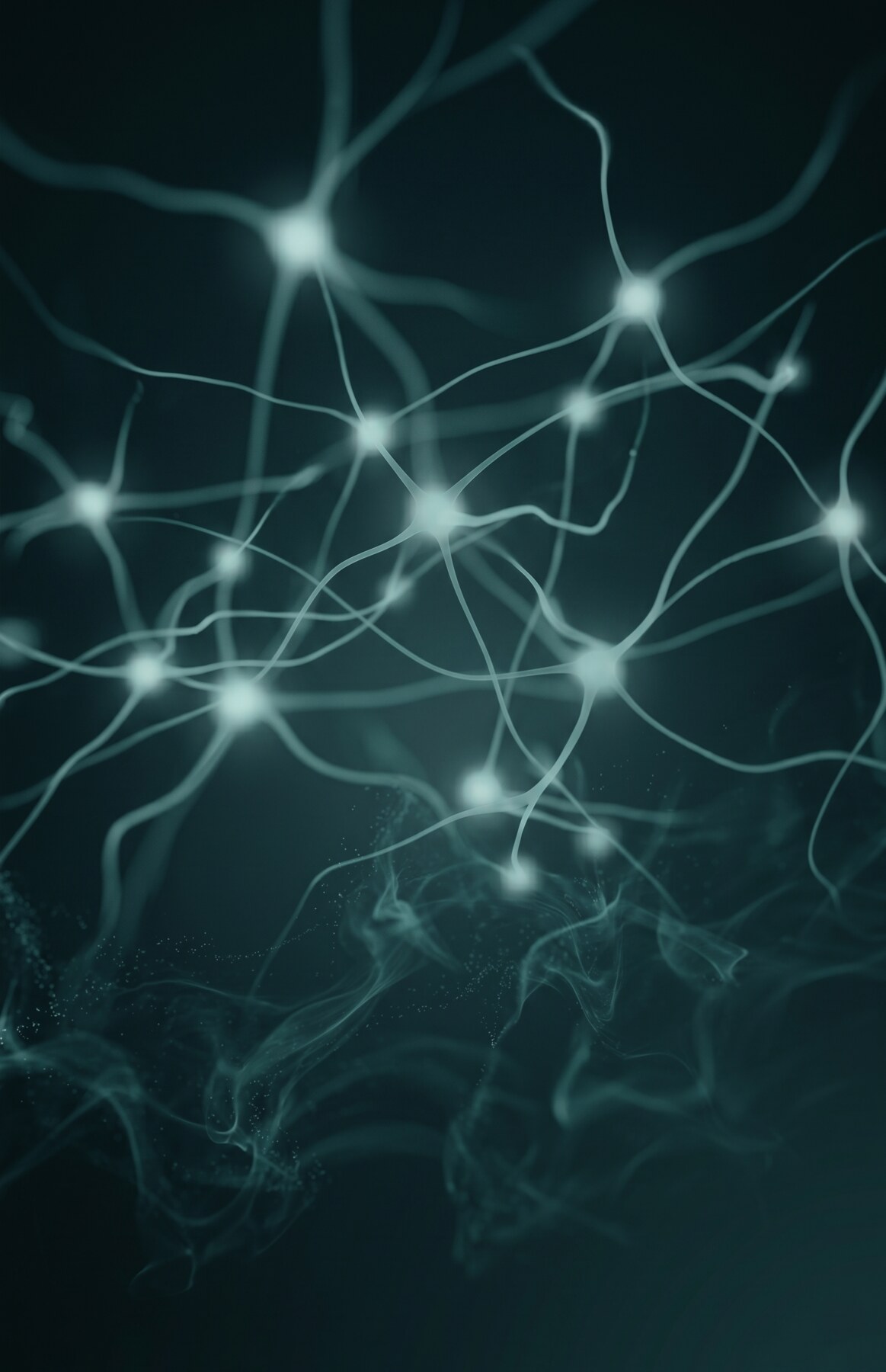
The brain is the most metabolically demanding organ in the body — it uses about twenty per cent of resting energy expenditure for around two per cent of body mass — and that demand makes it particularly vulnerable to oxidative damage. Research suggests molecular hydrogen can reach brain tissue without crossing barriers that more reactive antioxidants struggle with. The 2007 foundational paper in Nature Medicine by Ohsawa and colleagues established that hydrogen selectively neutralises hydroxyl radicals and peroxynitrite — the two species most directly implicated in neurological oxidative damage — while leaving signalling molecules like nitric oxide untouched. This selectivity is what makes hydrogen unusual among molecules being studied for neuronal protection.
Read more about the mechanism →
The selective antioxidant action in neurons
Most antioxidants are non-selective: they neutralise destructive free radicals but also disrupt the beneficial signalling molecules cells depend on for communication. This is why blanket high-dose antioxidant supplementation has produced mixed results in cognitive trials. Hydrogen’s mechanism appears to be different — selective enough to leave beneficial signalling intact while addressing the most damaging species. For neurons, which depend on tight signalling cascades for everything from memory formation to mood regulation, that selectivity may matter more than absolute potency.
Delivery matters
A 2020 paper by Sano and colleagues in the Journal of Clinical Medicine Research examined, in an animal model, what actually reaches the bloodstream when hydrogen is inhaled through a nasal cannula. The answer was that even at modest flow rates, blood hydrogen concentrations reached the levels prior research has associated with measurable biological effect. The Hydro Nova delivers at 1,500 ml/min — well above the threshold Sano’s work identified, and at the kind of dose serious research uses rather than the minimum that has been tested.

What It Feels Like
What it feels like.
The research describes things you can measure. ADAS-cog scores. Autonomic nervous function markers. Mood inventories. None of those is quite what a customer is describing when they tell us the afternoons stopped being the worst part of the day.
Eddie A. is one of our customers. He’d borrowed his brother’s machine, used it for three months, then bought his own. We asked him what changed, six months in. His answer wasn’t about energy in the boost-and-jolt sense. He didn’t say he had more pep, or felt sharper, or was getting more done. He said something quieter than that.
“It’s not a jolt. It’s just — I have my afternoons back.”
— Eddie A., Hydro Nova user
The phrase that stays with us is “back.” It implies a state he used to have and had stopped expecting to have again. That’s the register most of our customers eventually land on, when they describe what changed. Not feeling different — feeling like themselves. The 3 p.m. cliff stopped being a cliff. The morning didn’t take ninety minutes to start. The conversation in the meeting was easier to track. None of these things are dramatic. They’re recognised rather than measured. And they’re the part of the picture the research doesn’t quite reach.
This isn’t a stimulant. Hydrogen therapy doesn’t produce the spike-and-crash arc that caffeine or sugar produces. Many users report exactly the opposite — a steadiness, an absence of the afternoon dip, a sense of capacity sustained across the working day rather than borrowed from later. That’s what the Nishimaki and Mizuno data suggests on paper. What Eddie’s description does is put words to what it feels like from the inside.
Daily Practice
Making it part of a daily practice.
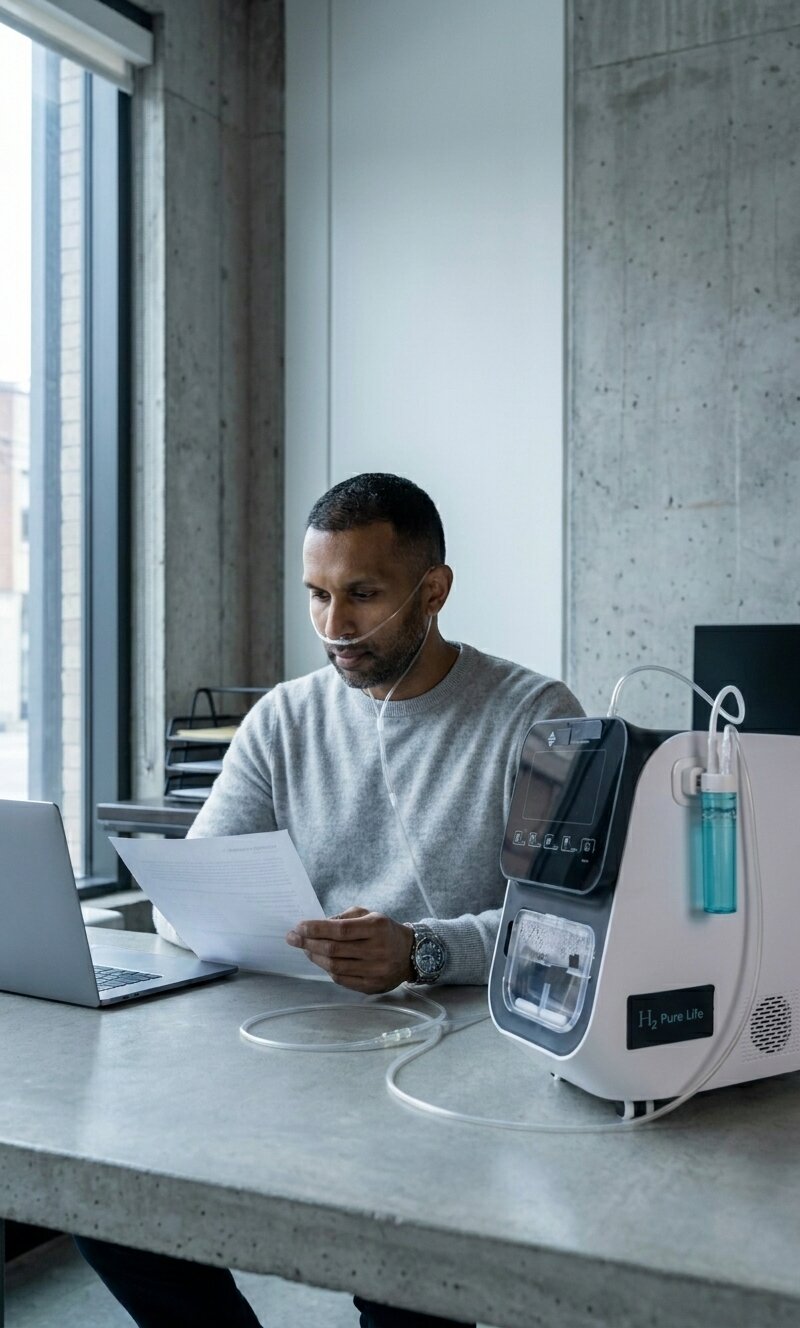
Most of the peer-reviewed work on molecular hydrogen — including both the Nishimaki cognitive trial and the Mizuno daily-life mood study — uses sustained daily use over weeks or months. The mechanism isn’t a one-off effect. It’s the cumulative result of supporting cellular machinery that’s working constantly. For energy and cognitive clarity specifically, our customers — and the underlying research — have pointed us toward what we call the daily practice.
Daily practice
20 to 30 minutes, once daily.
The session sits wherever it fits without changing the day around it. Many of our customers run it in the morning, with coffee, before email opens. Others prefer it as a wind-down at the end of the working day — after the demanding hours, before the evening starts. The principle is consistency rather than timing. Mizuno’s healthy-adult cohort used daily sessions across four weeks. Nishimaki’s MCI cohort used daily intake across twelve months. The cellular protection hydrogen offers is most relevant when it accumulates.
A twenty-to-thirty-minute session at 1,500 ml/min delivers blood hydrogen concentrations well above the research threshold (per Sano 2020, an animal model). The cannula is comfortable enough to forget. The machine runs quietly enough to take a call alongside. The water reservoir comfortably handles a daily thirty-minute session for weeks without intervention.
A 2021 safety study published in Critical Care Explorations (Cole et al., n=8) ran continuous hydrogen inhalation for 72 hours in healthy adults, with no adverse events recorded. Our 20-to-30-minute daily sessions sit comfortably inside that envelope.
Is It Right For You?
Is it right for you?
This isn’t a stimulant. It isn’t a treatment for any condition. What it is, for the people it suits, is a quietly considered piece of wellness technology — and the cognitive and mitochondrial research surrounding it is more interesting than almost anything else we’ve found in the space.
If your energy is steady and your afternoons feel like the rest of the day, you probably don’t need this. If the 3 p.m. dip has become the defining shape of the working day. If the morning takes longer to start than it used to. If you’ve tried the obvious things — better sleep, the cup of coffee, the walk at lunch — and you’re still in the place where mental clarity feels like it costs effort. If you’ve watched the older people in your life start to feel slower and you’d like to do what’s possible to keep your own machinery working. That’s the place where the research, and the people whose stories we’ve gathered, suggest hydrogen therapy may be worth exploring.
The Nishimaki 2018 trial gave its strongest signal in APOE4 carriers — the subgroup most genetically vulnerable to oxidative damage in the brain. The Mizuno 2017 study found improvements in healthy adults in daily life. The body of work surrounding them is over a thousand peer-reviewed studies and counting. We think the trajectory of the science is genuinely promising. We also think the only honest position is to say: we believe this is worth looking at carefully, and we’ll let the research speak for itself.
The Hydro Nova is the machine we built around the question of flow rate. The dose serious research uses — not the minimum that has been tested. Where the research sits is where the marketing usually doesn’t. That’s where we’ve tried to be.
If you’d rather hear how this fits into daily life, our customers have shared their experiences in their own words.