Use Case · Sleep
Hydrogen therapy for sleep
The recovery window that sets the day.
Sleep is the body’s most demanding piece of unseen work. Tissue repair, memory consolidation, hormonal recalibration, the clearance of metabolic waste from the brain — all of it happens in the dark, and almost none of it can be forced. What can change is the environment the body does that work in. Oxidative stress, low-grade inflammation and disrupted cellular signalling are three of the most studied disruptors of restorative sleep — and they are also three of the areas where molecular hydrogen has been studied most closely. A 2026 randomised controlled trial published in Medical Gas Research looked at this directly: seven days of hydrogen-oxygen inhalation, in adults with sleep disorders, produced significant improvements in sleep efficiency, total sleep time and self-reported sleep quality. It’s a small study, conducted over a short window. It’s also the first randomised controlled trial we’ve found that tests hydrogen therapy on sleep itself, rather than on a condition that disrupts sleep. We think it matters.
New to molecular hydrogen? Start with What is hydrogen therapy.

The Research
What the research suggests.
The most direct evidence sits in a 2026 single-blind randomised controlled trial published in Medical Gas Research (Gao et al., 16(2):98–102). Sixty-six adults with diagnosed sleep disorders were randomised into a control group or a hydrogen-oxygen inhalation group, receiving the gas via nasal cannula across seven consecutive days. Sleep was measured both subjectively, using the Pittsburgh Sleep Quality Index, and objectively, using actigraphy — a wrist-worn device that records total sleep time, wake time and sleep efficiency.
The control group’s sleep parameters did not change meaningfully over the seven days. The hydrogen-oxygen group’s did. Total sleep time and sleep efficiency improved significantly on days 3, 5 and 7. Wake time fell on days 3 and 7. Pittsburgh Sleep Quality Index scores were lower (better) in the hydrogen group than in the control group by day 7, and depression scale scores were lower too. The authors concluded that hydrogen-oxygen therapy improved sleep disorders by reducing wake time, relieving psychological stress and enhancing sleep quality.
We want to be careful with what that means. Sixty-six participants is a small sample. Seven days is a short window. Single-blind is not double-blind. None of this is a settled answer — but it is the first time a randomised controlled design has been applied to hydrogen therapy and sleep specifically, and the direction of the findings sits squarely with what a wider body of research has been pointing toward for over a decade.
That wider context matters. Across more than a thousand peer-reviewed studies on molecular hydrogen, three findings come up again and again: it selectively neutralises the most destructive free radicals, it appears to modulate the inflammatory signalling that disturbs cellular function, and it reaches tissue — including brain tissue — without disrupting beneficial physiological processes. Each of these has a plausible link to how well the body sleeps. None of them is “proof” the molecule helps you sleep. All of them suggest the mechanism is at least worth testing.
Gao et al., 2026 — Medical Gas Research 16(2):98–102
“Hydrogen-oxygen therapy effectively improved sleep disorders by reducing wake time, relieving psychological stress, and enhancing sleep quality.”
Read on PubMed →
The Mechanism
How it works for sleep.
Sleep is not a single biological event. It is a sequence — light sleep, deep slow-wave sleep, REM, and brief micro-arousals — and each stage depends on a different layer of physiology working properly underneath it. Three of those layers have been studied in relation to molecular hydrogen.
Oxidative stress and cellular signalling
The foundational 2007 paper in Nature Medicine by Ohsawa and colleagues demonstrated that molecular hydrogen can selectively neutralise hydroxyl radicals and peroxynitrite — the two most damaging reactive oxygen species — while leaving beneficial signalling molecules such as nitric oxide intact. Oxidative stress accumulates throughout the day and disrupts the cellular machinery the body relies on overnight. The selectivity of the antioxidant action is what makes hydrogen unusual among molecules studied for this role.
Read more about the mechanism →
Inflammation and the sleep-wake axis
Low-grade systemic inflammation is one of the most consistently identified physiological disruptors of sleep architecture. A growing body of research suggests molecular hydrogen may help modulate inflammatory signalling, including the cytokines most directly implicated in sleep disturbance. The Gao 2026 trial referenced the molecule’s anti-inflammatory profile as one of the proposed mechanisms underlying its sleep findings.
Mitochondrial function during overnight repair
Mitochondria — the energy-producing structures inside every cell — do significant repair work during sleep. Research suggests molecular hydrogen can cross cell membranes freely and reach mitochondria, where its action on oxidative by-products may support that overnight repair process. This is the layer of mechanism that ties hydrogen therapy to recovery more broadly, not only to sleep.
Delivery matters
A 2020 paper by Sano and colleagues in the Journal of Clinical Medicine Research examined, in an animal model, what actually reaches the bloodstream when hydrogen is inhaled through a nasal cannula. The answer was that even at modest flow rates, blood hydrogen concentrations reached the levels prior research has associated with measurable biological effect. The Hydro Nova delivers at 1,500 ml/min — well above the threshold Sano’s work identified, and at the kind of dose serious research uses rather than the minimum that has been tested.

What It Feels Like
What it feels like.
This is the part the research can’t quite reach. The PSQI is a questionnaire. Actigraphy is a wrist sensor. They tell you about measured sleep — but the felt experience of sleeping well isn’t really measured. It’s recognised. It’s the way you don’t wake at three a.m. with your jaw clenched. It’s the day after. It’s the moment, somewhere around the second week of doing this consistently, when you realise the alarm went off and you weren’t already half-awake waiting for it.
Vicki, one of our customers, put it more simply than we ever could.
“I sleep through the night now. I had genuinely forgotten what that felt like.”
— Vicki, Hydro Nova user
She didn’t say she sleeps more. She said she sleeps through — and that the contrast was what surprised her. That phrase, “I had genuinely forgotten,” is the one that stays with us. It’s not a claim about cure. It’s a claim about return. Many users report the same thing in different words: not feeling different, exactly, but feeling like themselves on the days that follow.
That’s the register the research is starting to catch up with. The Gao 2026 trial measured wake time falling and sleep efficiency rising. Vicki’s description is what those numbers feel like from the inside.
Daily Practice
Making it part of a daily practice.
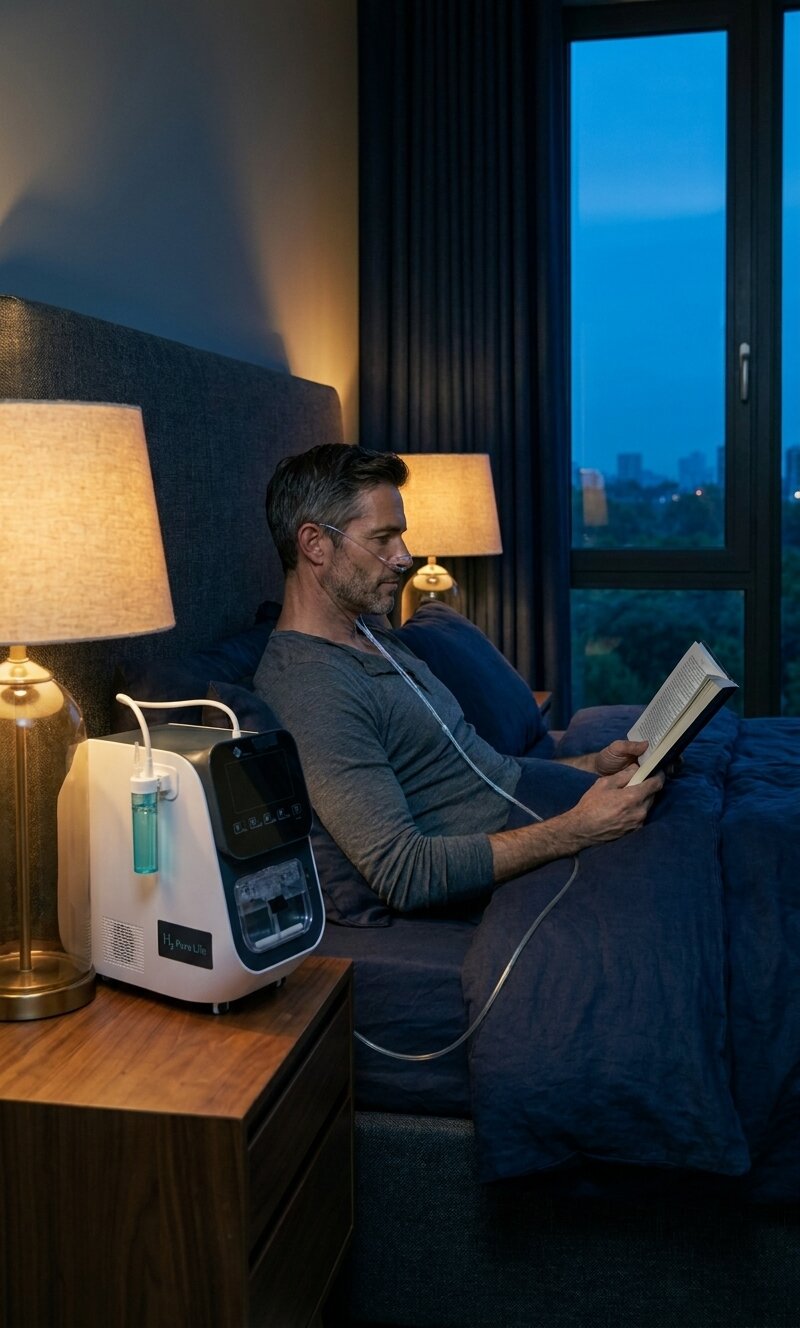
Most of the peer-reviewed work on hydrogen therapy uses session durations between 30 and 60 minutes. The Gao 2026 sleep trial used inhalation across seven consecutive days. For sleep specifically, our customers — and the underlying physiology — have pointed us toward what we call the night-time session.
Night-time session
60 to 90 minutes, before sleep.
The session sits in the window where most people are already winding down: reading, watching something quiet, not on a screen if they can help it. The cannula is comfortable enough to forget. The machine runs in the background. The 60-to-90-minute duration overlaps the window in which blood hydrogen concentrations stay elevated (per Sano 2020, an animal model, and broader pharmacokinetic work), which means the molecule is still active in the bloodstream as the body begins its transition into sleep.
Some users prefer the session to end just before they get into bed. Others prefer it to overlap with the first thirty minutes of trying to sleep. There is no single right answer. The principle is consistency — most of the research on biological effect uses repeated, daily sessions rather than one-off use, and the Gao 2026 trial showed measurable change beginning around day three.
The Hydro Nova at 1,500 ml/min delivers the flow rate the research actually used. The session is quiet enough to read through. The water reservoir runs comfortably through 90 minutes without intervention.
A 2021 safety study published in Critical Care Explorations (Cole et al., n=8) ran continuous hydrogen inhalation for 72 hours in healthy adults, with no adverse events recorded. Our 60-to-90-minute night-time sessions sit comfortably inside that envelope.
Is It Right For You?
Is it right for you?
This isn’t a cure. It isn’t a treatment for any condition. What it is, for the people it suits, is a quietly considered piece of wellness technology — and the research that surrounds it is more interesting than almost anything else we’ve found in the space.
If you sleep well already, you probably don’t need this. If you wake at three and stay there. If the body that used to do its overnight work without asking has stopped doing it reliably. If you’ve tried the things you’d reasonably try — the magnesium, the cooler room, the no-phone-after-nine — and you’re still in the place where mornings feel like a slow climb out of something. That’s the place where the research, and the people whose stories we’ve gathered, suggest hydrogen therapy may be worth exploring.
The Gao 2026 trial is a beginning, not an endpoint. We think the trajectory of the science is genuinely promising. We also think the only honest position is to say: we believe this is worth looking at carefully, and we’ll let the research speak for itself.
The Hydro Nova is the machine we built around the question of flow rate. The dose serious research uses — not the minimum that has been tested. Where the research sits is where the marketing usually doesn’t. That’s where we’ve tried to be.
If you’d rather hear how this fits into daily life, our customers have shared their experiences in their own words.